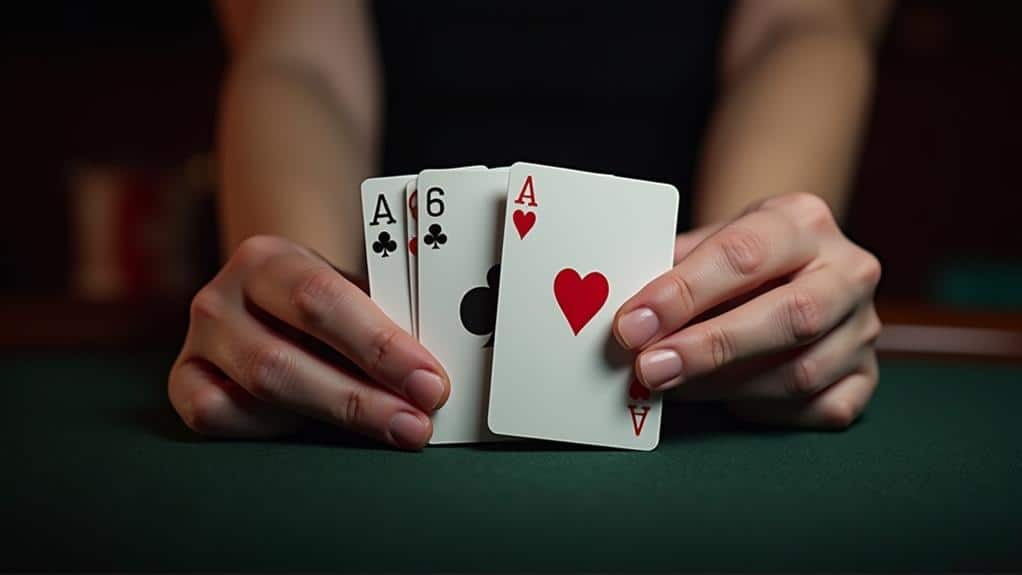
In blackjack, ‘hard’ hands do not contain an Ace or when the Ace must be counted as 1 to avoid going over 21. For example, a total of 17 without an Ace is a hard hand.
On the other hand, ‘soft’ hands include an Ace valued at either 1 or 11, offering more flexibility in gameplay. Knowing the distinction between hard and soft hands is vital for employing the right strategies to enhance your chances of winning.
By understanding these concepts, players can make more informed decisions at the blackjack table to improve their outcomes. Keep reading to learn more about hard and soft and what these terms mean in Blackjack.
Keep reading to learn more about hard and soft in Blackjack. And if you need Blackjack table rentals in Long Island and beyond, reach out for your free quote today.
Definition of Hard Hands

Hard hands in blackjack refer to hands that do not contain an Ace, or if they do, the Ace is counted as 1 to avoid busting. This means that the total value of the hand is fixed and cannot be changed.
Examples of hard hands include a 10 and a 7, totaling 17, or a 9 and a 6, totaling 15.
One advantage of hard hands is that they are more straightforward to play compared to soft hands. Players do not need to worry about the Ace changing value, simplifying strategic decisions.
However, hard hands are more likely to bust if another high-value card is drawn.
Understanding how to play hard hands effectively is essential in mastering the game of blackjack.
Characteristics of Soft Hands
Soft hands in blackjack are characterized by the presence of an Ace that can be valued as either 1 or 11 without causing the hand to bust. When playing blackjack, understanding the characteristics of soft hands is essential for making strategic decisions.
Here are four key traits that define soft hands and the advantages they offer:
- – Flexibility: Soft hands provide players with the flexibility to adjust the value of the Ace based on the other cards in the hand.
- – Reduced risk of busting: The ability to switch the Ace value minimizes the risk of going over 21.
- – Higher potential for improvement: Soft hands have a higher likelihood of improving with additional cards.
- – Strategic opportunities: Soft hands create opportunities for players to double down or hit for better chances of winning.
How to Identify Hard Hands

Identifying hard hands in blackjack involves understanding the total value of the cards without the presence of an Ace.
These hands typically have fixed rules for play, making them easier to strategize compared to soft hands.
Recognizing when you have a hard total and following the specific guidelines for these hands can markedly improve your decision-making in the game.
Identifying Hard Totals
A fundamental aspect of mastering the game of Blackjack is the ability to differentiate between different types of hands based on their total value.
When it comes to identifying hard totals, here are four key points to keep in mind:
- – Total Value: Hard hand scenarios involve hands without an Ace, or where the Ace must be counted as 1 to avoid busting.
- – No Room for Flexibility: In hard hand exceptions, the total value is fixed, leaving no room for adjustment based on the player’s strategy.
- – Strategic Decisions: Identifying hard totals allows players to make strategic decisions on whether to hit, stand, or double down.
- – Risk Assessment: Understanding hard hand scenarios helps players assess the risk associated with their current hand.
Mastering the identification of hard totals is essential for making informed decisions during a game of Blackjack.
Rules for Hard Hands
Understanding the rules for hard hands in Blackjack is essential for players aiming to enhance their strategic gameplay. Hard hands are hands that do not contain an Ace or hands where the Ace is counted as 1 to avoid busting.
When dealt a hard hand, players need to employ specific strategies to maximize their chances of winning. Basic hard hand strategies include standing on hard totals of 17 or higher, hitting on totals of 8 or less, and hitting on totals of 12-16 when the dealer’s upcard is 7 or higher.
For example, a hard 16 should typically be hit against a dealer’s 10. By mastering hard hand strategies and knowing when to hit, stand, or double down, players can make more informed decisions and improve their overall Blackjack performance.
Strategies for Soft Hands
Soft hands in Blackjack present a unique strategic challenge for players aiming to optimize their chances of winning.
When dealing with soft hand strategies and advantages, players need to evaluate the following:
- – Double Down: Knowing when to double down on a soft hand can greatly increase potential winnings.
- – Hit or Stand: Deciding whether to hit or stand with a soft hand depends on the dealer’s upcard and the current game situation.
- – Splitting: Some strategies suggest splitting a soft hand in specific scenarios to improve the odds of winning.
- – Insurance: Understanding when to think about taking insurance on a soft hand can be critical in certain situations.
Importance of Hard Vs. Soft

Understanding the distinction between hard and soft hands in Blackjack is essential for devising effective playing strategies.
Hard hands involve a fixed value for the Ace, while soft hands allow for more flexibility due to the Ace’s dual value.
Hard Hands Explained
When playing blackjack, one of the fundamental concepts to grasp is the distinction between hard and soft hands. Hard hands are those without an Ace or where the Ace must count as 1 to avoid busting.
Here are four important points to understand about hard hands:
- Hard hand scenarios require different strategies than soft hands.
- Knowing when to hit or stand with a hard hand is important for success.
- Hard 12-16 hands are the most challenging in blackjack.
- Doubling down on hard 9-11 can be advantageous in the right circumstances.
Mastering hard hand strategies is essential for improving your blackjack game and increasing your chances of winning.
Soft Hands Strategy
In the domain of blackjack strategy, the differentiation between hard and soft hands plays a vital role in determining the best course of action during gameplay.
Soft hands, characterized by the presence of an Ace valued as 11, offer players flexibility and strategic advantages. When it comes to soft hand strategies, players have the advantage of being able to hit without the risk of busting since the Ace can be counted as 1 if needed.
Understanding the various soft total variations is essential in optimizing gameplay. For instance, a soft 18 can be a powerful hand, while a soft 13 requires careful consideration.
Implementing effective soft hand strategies based on the specific soft total variations can greatly increase the odds of winning in blackjack.
FAQ
Can You Split a Soft Hand in Blackjack?
In blackjack, maneuvering soft hand strategies is vital. When considering the option to split aces, it’s important to remember that a soft hand cannot be split. This strategic choice can impact the outcome considerably in a game of blackjack.
What Is the Best Strategy for Playing Hard Hands?
When playing blackjack, mastering the strategy for hard hands is essential. Ideal play involves considering the dealer’s upcard and the value of the hand. Decisions on hitting, standing, or doubling down should be based on statistical probabilities to maximize success.
Are There Any Special Rules for Doubling Down With Soft Hands?
When considering soft hand strategies in Blackjack, players have unique double down options. Generally, doubling down with a soft hand is advantageous against certain dealer upcards. This strategic move can maximize potential gains while minimizing risks.
How Do You Handle a Hard 16 Against a Dealer’s 10?
When facing a hard 16 against a dealer’s 10 in blackjack, the best strategy is to hit. Although it’s risky, the odds favor taking the additional card to increase the chances of improving your hand and beating the dealer.
Can You Explain the Concept of Insurance in Blackjack?
In blackjack, insurance is a side bet offered when the dealer’s upcard is an Ace. It pays 2:1 if the dealer has a natural blackjack. However, statistically, it is not a profitable bet in the long run.
Conclusion
In summary, understanding the distinction between hard and soft hands in blackjack is essential for developing effective strategies and maximizing wins. Hard hands refer to hands without an ace, while soft hands include an ace that can be valued as 1 or 11. Identifying and playing these hands correctly can greatly impact the outcome of a blackjack game. By implementing proper strategies for both hard and soft hands, players can increase their chances of success at the table.